TL:DR A Synopsis of the recent Building the Economic Case for Creative Health Webinar
Image Credit: Arts Council Wales
Building the Economic Case for Creative Health
TL:DR A synopsis of the recent Building the Economic Case for Creative Health Mobilising Community Assets (MCA) to Tackle Health Inequalities Webinar Hosted on Friday 27 March 2026.
The Green Book provides UK government guidance on how to appraise policies, programs and projects.
The appraisal of social value, also known as public value, includes monetising all significant costs and benefits that affect the welfare of the population, not just market effects, this is called social cost benefit analysis.
The value of an outcome is comprised of the direct impact on an individual’s quality of life (primary benefits) and the spillover benefits to society such as reduced NHS costs and benefit payments (secondary benefits).
Why do we need Culture and Heritage Capital (CHC)?
Unlike other sectors, there is no sector specific guidance on valuing the impact of Creative Health. Consequently, the benefits of culture and heritage are often undervalued or implicitly valued at zero.
The Department for Culture, Media & Sport (DCMS) are currently producing Guidance and Values for Appraisal and Evaluation with the aim that this will become supplementary to The Green Book.
Templates will cover standardised data collection and outcome metrics to create standardised reporting.
This new capitals approach, aligns culture and heritage with Nature.
Creative Health is already delivering value for society – this framework will ensure that value is measured, evidence and recognised in public decision making.
Findings from the research indicate that currently the sector is collecting 81% of the data required for a full economic evaluation about the programme (what type of activity, where and how long), 42% of the data required about the Participants (Background and socio-economic context) but only 24% of data around Outcomes (How people felt before and after).
To enable full economic evaluation, core metrics featured within the Green Book are required.
Warwick Edinburgh Mental Wellbeing Scale (WEMWBS) is being used prolifically across the sector, but there isn’t currently a tool that allows for this to be directly mapped into a monetary value. However, the data collected provides useful additional context for business cases.
ICECAP = Measures of wellbeing for use in certain types of economic evaluation. The measures are conceptually linked to Amartya Sen’s capability approach which defines wellbeing in terms of an individual’s ability to ‘do’ and ‘be’ the things that are important in life.
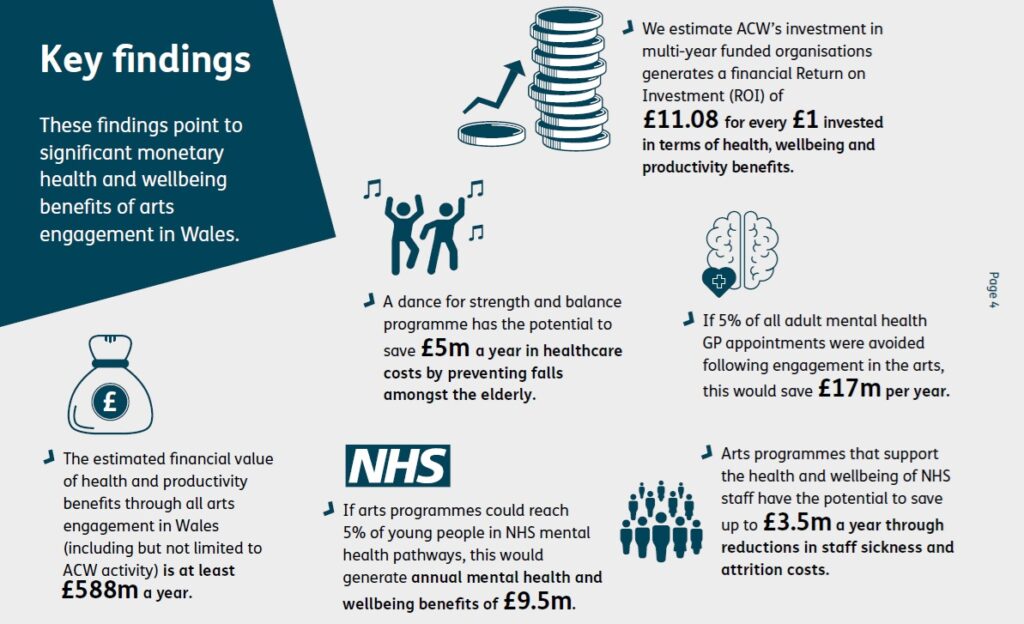
Arts Council Wales presented the first-ever national investigation into the economic impact of the arts on the NHS and social care in Wales, as well as wider population health and societal impacts.
Frontier Economics – Monitising Health & Wellbeing was a baseline for Arts Council Wales report.
Headlines = Creative Health Intervention £1 ROI £11.08 vs Public Health intervention of £1 ROI £4
Burnout in NHS = If 10% of the workforce were engaged in Arts & Culture workplace initiatives = £3.5m savings benefit.
Investing in Creative Health = Investing in Public Health
Elemental is a new Digital Social Prescribing software which has been launched in Birmingham and Solihull ICB
Data from over 4,500 participants using social prescribing has shown a decrease in GP appointments, A&E attendance and Hospital Admissions.
Mobilising Community Assets is a three-phase UK Research and Innovation (UKRI) funded Research Programme running from 2021 to 2027.
You can watch the full recording here: Building the Economic Case for Creative Health – MCA Webinar
For ways to add your voice to the Creative Health eco-system, join the new Creative Health Interest Meetings (CHIMe) and/or sign up to the Norfolk & Suffolk Creative Health Mailing List to be kept informed of developments happening across the regions.
Similar stories
 Blog posts
Creative Health Interest Meetings (CHIMe)
CHIMe is a new initiative bringing together professionals interested in Creative Health across Norfolk and Suffolk.
Find out more Blog posts
Creative Health Lead – March Roundup
It’s been a busy few months for me as I continue my work as Creative Health & Equity Lead across Norfolk & Suffolk. Here’s a round up from March.
Find out more