Creative Health – Two opposing prejudices
Image Credit – Josh Dear
As part of my role as Creative Health & Equity Lead for Norfolk & Suffolk, I regularly like to set aside time for reading content to keep abreast of developments within the Creative Health field.
I recently read Against transcendentalism and reductionism in arts and health published on the Springer Nature Research Communities website. Whilst the paper has a distinctly biomedical research focus to evidence the benefits of Arts in Health, it does raise two interesting points.
The first is the belief that the Arts in Health (or Creative Health) field remains constrained by two opposing prejudices. The first prejudice is described as aesthetic transcendentalism. This is the view that creativity is for the minority, the hallowed few, who transcend mere mortals and earn huge amounts for their celebrated creations. In part, reinforced by our capitalist society and the underlying motive that everything needs to produce a profit, alongside an academic system that sets in opposition narrow concepts around who is and isn’t artistic.
This perspective, has become a social norm (a shared standard of acceptable behaviour by a group) that has become engrained into our society and as such now renders creativity and creative activity a class issue and elitist, only something that individuals with time, money and opportunity are able to partake in. Therefore, rendering it absent from broader discussions around public health and neglected from public discourse due to a long-held belief that “I’m just not creative”.
The second prejudice is the bio-medical presumption, prevalent within our healthcare system and endemic throughout modern western society. The notion that the doctor always knows best, due to their extensive training. Within this system, a biased focus is given to interventions and solutions that can be evidenced by biological changes and quantitative measurable outcomes.
In contrast, the qualitative, narrative-based evidence that demonstrates the impact and influence of creative interventions is viewed to be unreliable, indistinct and deficient in clinical rigor. However, since the late 20th century, the field of Narrative Medicine has emphasised that narrative is central to medicine and this area of research is strengthening the argument for its robustness. (Narrative medicine, narrative practice, and the creation of meaning, Launer, John et al. The Lancet, Volume 401, Issue 10371, 98 – 99)
The second point this article raises is that despite arguing against the bio-medical model of presumption, the evidence gathered within the research is still quantitative, mechanistic and distinctly medicalised both in language and tone. Whilst I support wholeheartedly the arguments presented, the rhetoric presented to oppose the prejudices doesn’t emphasise the myriad benefits provided by Creative Health initiatives.
Initiatives that focus on qualitative evidence in order to gain an understanding of individuals’ social reality, an equally important aspect of assessing and understanding how to return or maintain optimum health. By highlighting the qualitative research in juxtaposition to the bio-medical model of presumption, the complex phenomena and insight gained into people’s experiences and perspectives of Creative Health solutions is overlooked and an opportunity to underline the benefits of Arts in Health squandered.
What are your thoughts on these points?
Does your experience highlight these thoughts or oppose them?
You can read more about Claire’s role as Creative Health & Equity Lead on the Creative Health and Wellbeing Alliance page
or
Sign up to the Norfolk & Suffolk Creative Health Mailing List to be kept informed of developments happening across the regions.
Similar stories
 News
News
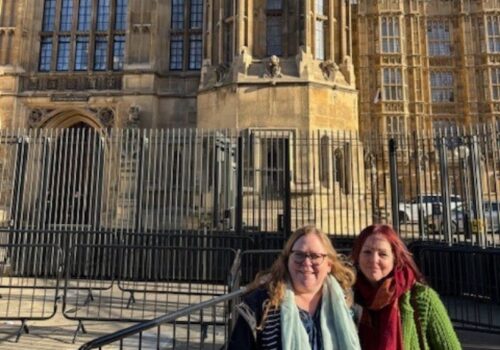
Suffolk Artlink visits the House of Lords
Lucy Chandler shared her experience of how participating in creative activities has positively impacted her health and wellbeing.
Find out more Blog posts
Creative Health Interest Meetings (CHIMe)
CHIMe is a new initiative bringing together professionals interested in Creative Health across Norfolk and Suffolk.
Find out more